If you look solely at the topline
figures for October 2025, the retail PC market appears to be entering
a golden age.
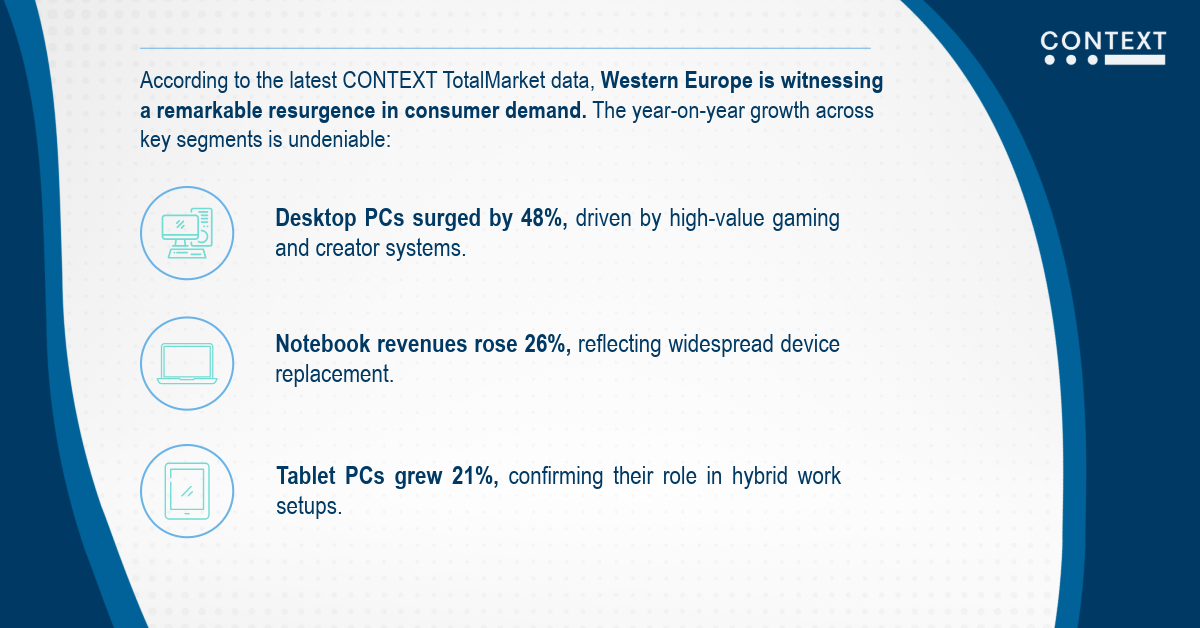
According to the latest CONTEXT
TotalMarket data, Western Europe is witnessing a remarkable
resurgence in consumer demand. The year-on-year growth across key
segments is undeniable:
- Desktop PCs surged by 48%, driven by
high-value gaming and creator systems.
-
Notebook revenues rose 26%, reflecting widespread
device replacement.
- Tablet PCs grew
21%, confirming their role in hybrid work setups.
But before adjusting forecasts for
a permanent bull market, retailers must look closer. The underlying
drivers suggest this is a complex peak that requires careful
navigation to avoid dead stock in 2026.
The "Forced" Upgrade
Cycle The primary engine behind this surge is the Windows 10
end-of-support deadline. Consumers are realizing their legacy devices
cannot support the security requirements of modern operating systems,
triggering a wave of "forced" upgrades. This is a
compliance-driven event pulling demand forward, rather than a purely
organic economic shift.
The Performance Shift &
The AI Gamble There is a silver lining beyond simple
compliance. We are tracking a shift toward higher-performance
hardware, with consumers prioritizing power, cooling, and
longevity. Simultaneously, the "AI PC" narrative is
gaining traction, with NPU-equipped systems promising enhanced
security and productivity.
However, as James Bates, Senior
Retail Analyst at CONTEXT, notes, "When the Windows deadline
disappears, the AI PC message will need to mature quickly. Consumers
will expect compelling, demonstrable benefits if they’re going to
continue investing at current levels."
The Storm Clouds for 2026
The market faces considerable risk heading into next year. Once the
urgency of the Windows deadline fades, replacement cycles are
expected to revert to longer intervals. Complicating this picture,
costs for essential components—specifically DRAM and NAND Flash—are
projected to rise throughout 2026, putting pressure on retail prices
just as volume potentially softens.

The Requirement: Navigating
Volatility with Precision Managing the transition from this
deadline-driven surge to a cost-sensitive 2026 requires a solid
understanding of actual sell-out performance. The current volatility
means historical data is less predictive; you need to see what is
moving now.
The Next Step: Stay Ahead of
the Correction. To consistently maintain a precise view of
market health and understand how pricing pressures are evolving in
real time, you need continuous, granular intelligence. Data from
CONTEXT TotalMarket delivers detailed, SKU-level retail
sell-out sales tracking across 12 countries and 46 technology
categories, helping retailers distinguish between temporary
compliance buys and sustainable performance upgrades, allowing for
safer inventory planning.
The Retail Pulse Newsletter
delivers the objective analysis and critical, imminent data updates
you need to sharpen your forecasting and inventory strategy before the
competition can react.
Subscribe
now to receive findings from October technology sales and the
full market outlook.