London, 9 July 2026 – The global 3D printer
market experienced robust growth in the first quarter of 2026,
driven by an explosive Entry-level segment and accelerating demand
for high-end Industrial systems. According to the latest analysis by
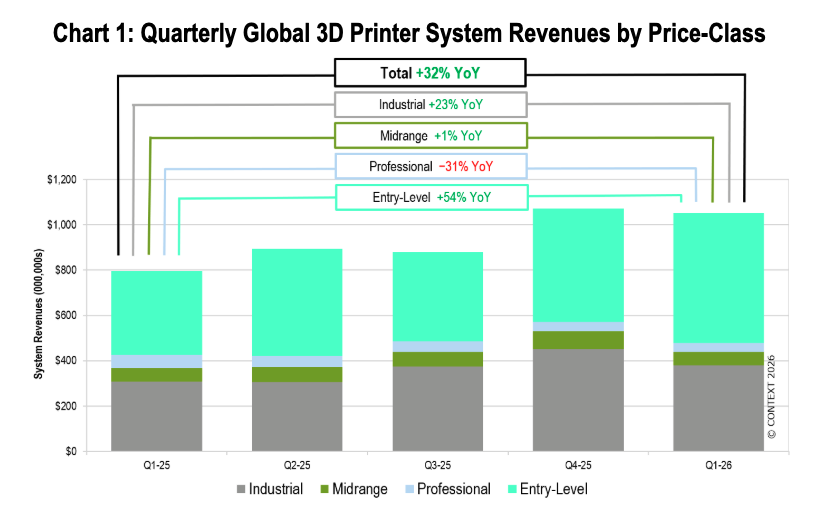
global market intelligence firm CONTEXT, the industry enjoyed a +32%
year-on-year (YoY) gain in total hardware system revenues. Most of
the growth came by way of accelerated Entry-level shipments, with a
+39% unit growth translating into a +54% surge in revenues.
Additionally, Industrial revenues rose nicely, up +23% from a year
ago on the back of an +18% increase in unit shipments.
"The current market presents a disparate
demand outlook," said Chris Connery, VP of Global Analysis at
CONTEXT. "While some vendors report exceptionally strong demand,
especially related to global conflicts and defence initiatives, others
report challenges associated with the many unknowns including ongoing
global conflicts, fears of rising inflation, higher interest rates
impacting capital investments, and a sluggish European economic
environment. However, the strong performance of the Industrial sector,
marking its third consecutive quarter of growth after two years of
declines, is a clear indicator of the technology's continued
integration into volume production.”
Industrial Systems
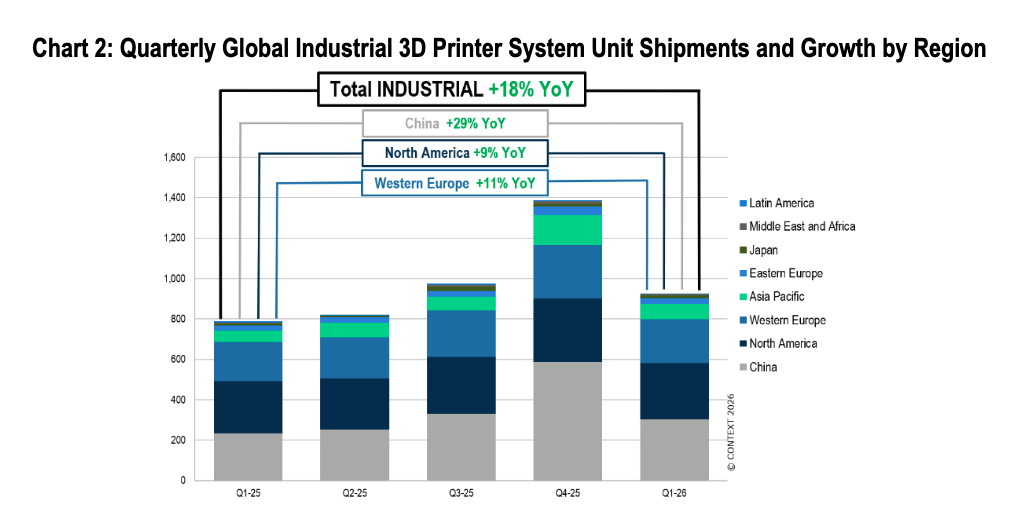
Global shipments of Industrial price-class
systems (>$100K) were up +18% in Q1-26. Nine out of the top ten
global vendors shipped more units in Q1-26 than a year ago and
Industrial shipments were up across all major regions: China +29%,
North America +9% and Western Europe +11%. China remains the world’s
largest market for Industrial 3D Printer system shipments, with most
of its demand fulfilled by domestic suppliers.
-
Metals:
Industrial Metal system shipments rose +10% YoY in Q1-26.
Powder Bed Fusion (PBF) remains the dominant technology,
accounting for 81% of the total Industrial Metals market,
with Metal PBF unit shipments up +24% YoY. Western leader
EOS had a strong quarter seeing its Metal shipments more than
doubled from a year ago, and separately announced the biggest
contract in its history, with a defence drone maker. Some reports
even indicate Metal PBF demand is outstripping supply in the West,
suggesting 2026 may be supply-limited as machine OEMs catch up on
production. In China, HBD, Farsoon and BLT all saw strong YoY
shipment growth with the latter two citing incredibly strong
demand in the 3C sector (Computer, Communication, and Consumer
Electronics.) This demand, strong in Q4-25 and carrying over into
Q1-26, was reportedly mostly for the production of titanium mobile
phone components, specifically hinges for foldable phones and
titanium smartphone frames. While such demand in China shifted the
overall market back toward lower-priced Metal PBF systems, other
vendors saw continued success with more advanced system sales.
Nikon SLM Solutions shipped more of its advanced, large
build-volume, multi-laser NXG systems than ever before, a +42% YoY
increase in unit shipments that put the company at the top of the
category's revenue leaders.
-
Polymers: Global shipments for Industrial Polymer
systems surged +31% YoY, heavily skewed by a massive shipment
acceleration from Carbon thanks to growing demand for
lattice-based consumer solutions (evidenced by their recent
announcement of relationship with DDK for the production of
bicycle saddles.) Excluding Carbon, Industrial Polymer shipments
were still up a healthy +14%. Additionally seeing growth in the
period was the Polymer Powder Bed Fusion space with global
shipments up +30% from a year ago thanks to strength from HP and
EOS, both of which saw shipments rise +100% from the year ago
quarter. Drone production remains a demand catalyst for Polymer 3D
printing. OEMs of Industrial Material Extrusion printers capable
of high-performance polymer processing, and of Polymer Powder Bed
Fusion systems, cited demand from this market as a driver of
shipment growth in the period. The period also saw one of its
global unit leaders in the Polymer machine space, UnionTech, issue
an IPO Prospectus in hopes of going public later this year on the
Hong Kong Stock Exchange.
Midrange and Professional Systems
The middle of the market (Professional + Midrange
price-classes) remained challenged mostly by the cannibalization of
Material Extrusion (FDM/FFF) demand by the Entry-level. That is
changing, though, as new product introductions and corporate
consolidation reshape the segment.
Midrange ($20K–$100K): Global shipments dropped
-6% YoY. The Polymer PBF sub-segment, however, is running hot, with
shipments up +48% YoY. This new Midrange price class for production
Polymer-PBF machines is becoming crowded: Formlabs has entered with
its newly announced Fuse X1, and HP has announced its forthcoming
sub-$60K Jet Fusion 1200. Both will join solutions from Raise3D, which
had strong initial shipments in the quarter as its market introduction
continued, and a range of others from vendors across the globe.
Professional ($2.5K–$20K): Shipments contracted
-22% YoY, and revenues fell -31%. New technology in this price class,
including Composites and full-colour Material Jetting, are set to
boost the segment in coming quarters. Composites look to get a lift
with Stratasys' planned acquisition of Markforged from Nano Dimension.
Entry-Level Systems
The Entry-level category (≤$2,500) alone
accounted for 54% of all 3D printing system revenues in the period.
Global shipments were up +39% YoY. China has become to the consumer
3D printing market what Japan was to consumer electronics in the
1980s: almost all of the ingenuity, in technical advances like AI
and multi-colour printing, and in price innovation, is coming out of China.
Bambu Lab continued to lead in global market
share, with the top four vendors in the category, Bambu Lab,
Creality, Elegoo, and Anycubic, collectively accounting for 88% of
all printers shipped globally in the period. The strongest YoY
shipment growth came from Flashforge, which saw printer shipments
jump over 120% in the price class in the period. Demand is
increasingly driven by massive "print farms" across the
globe, from China to the US, serving as a vehicle for "local
production" leveraging these Chinese-made machines. The period
also saw Creality go public on the Hong Kong Stock Exchange on
29-MAY-26, the first consumer-centric 3D printing company to do so.
*Price classes: Entry-level <$2,500;
Professional $2,501 to $20,000; Midrange $20,001 to $100,000;
Industrial above $100,000