London, 15 January 2026 – Global
shipments of Industrial 3D printing systems moved back into growth in
the third quarter of 2025, as rising demand from aerospace and defence
and a renewed surge in China’s domestic market helped lift the
high-end of the industry out of a prolonged slowdown. The low-end
Entry-level remained white-hot with rising shipments attracting new
financial investment.
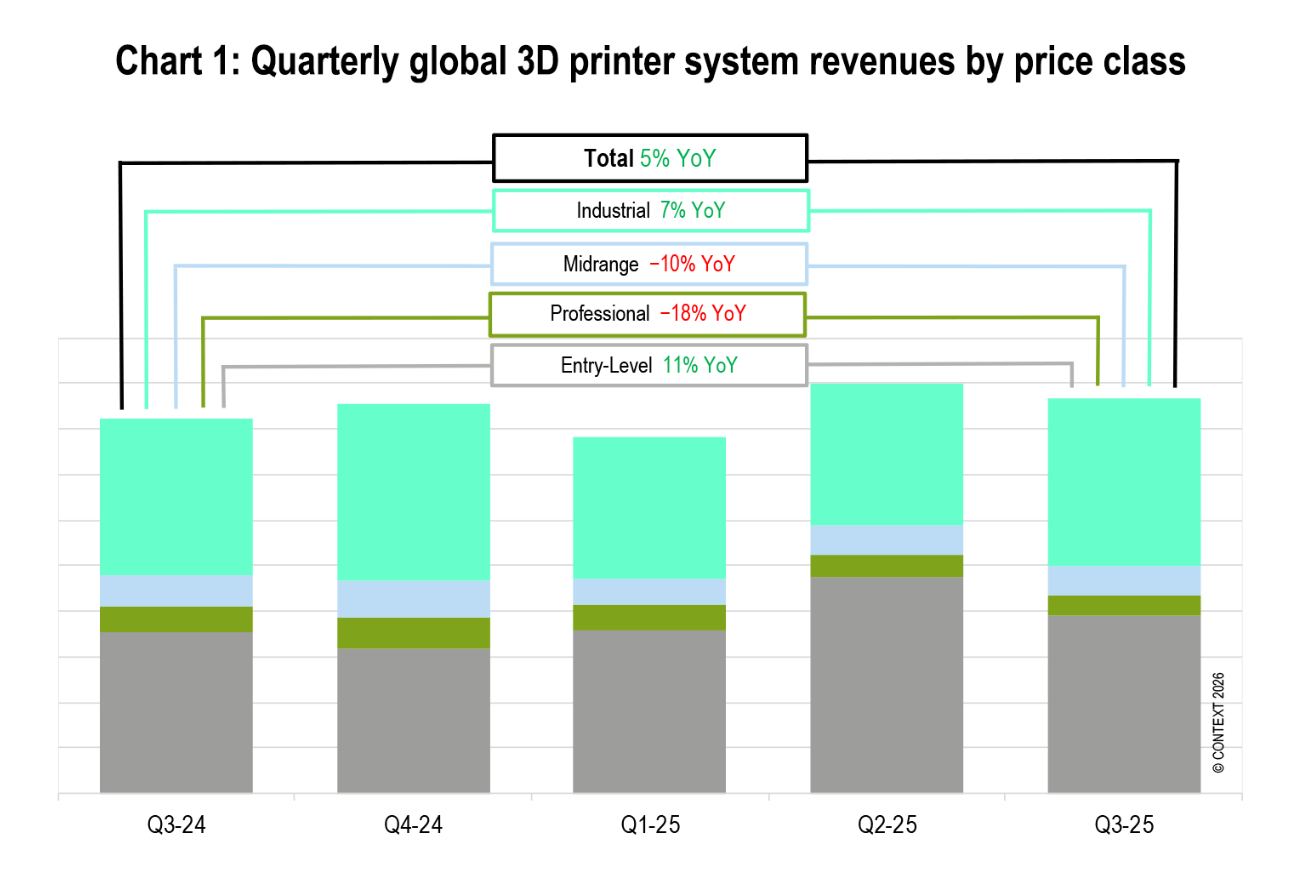
New data from CONTEXT shows total
hardware system revenues rose 5% YoY in Q3 2025, supported by growth
at both ends of the market. Industrial systems benefitted from a
recovery in metal platforms, while the Entry-level continued its
exceptional run.
After two years of weak demand at
the high end, the latest figures suggest conditions are beginning to
stabilise for Industrial machine shipments.
The mood across the high end of the
market is still cautious, but it is no longer defensive. The industry
has moved past the expansion-at-any-cost phase and is now
concentrating on sectors where additive manufacturing is already
delivering clear economic value. Aerospace, defence and domestic
Chinese manufacturing are doing most of the heavy lifting.
Industrial And Midrange Systems: Metal Drives the Recovery
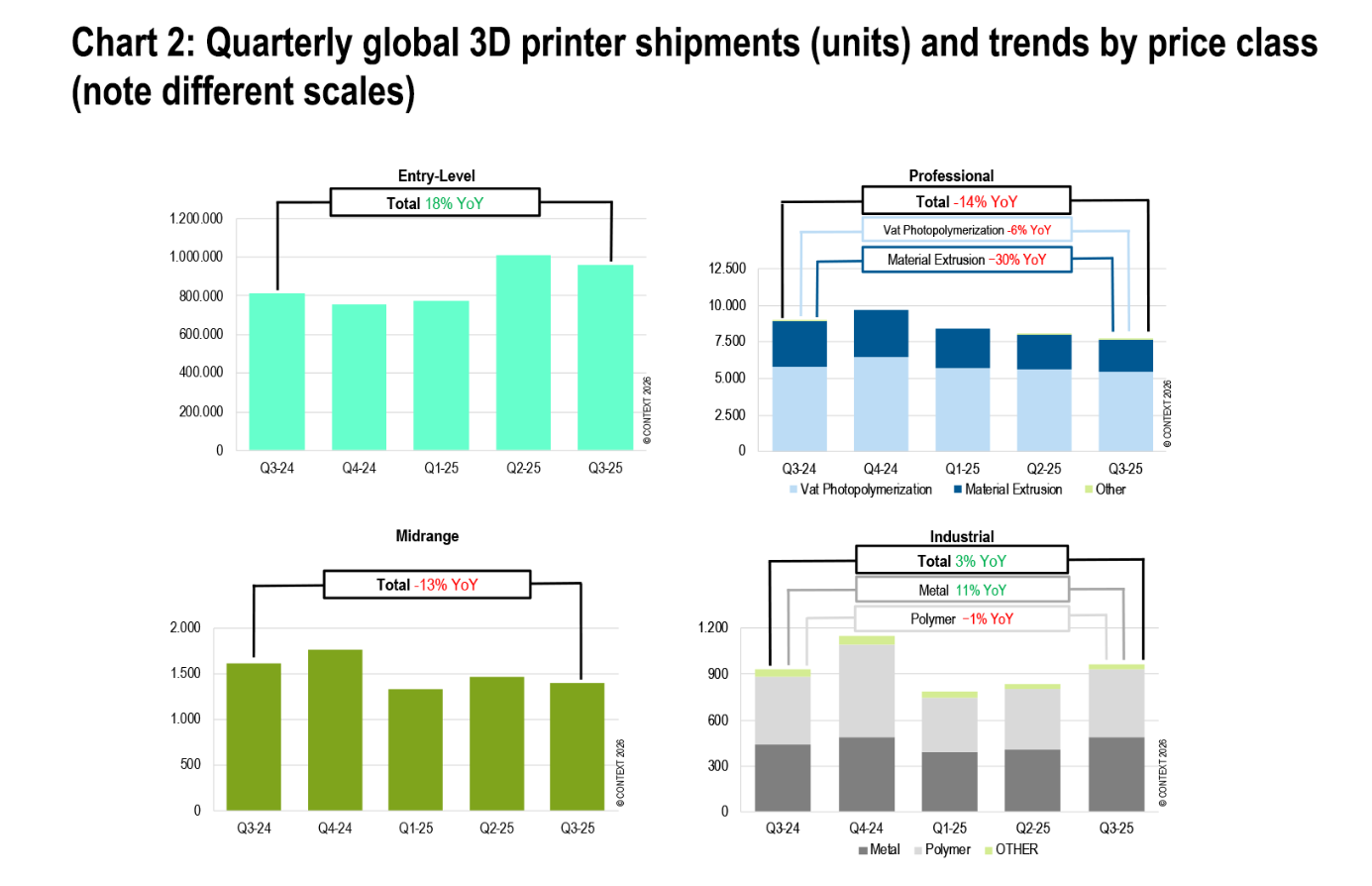
Industrial system shipments,
defined as systems priced above $100,000, rose 3% YoY in unit terms.
Growth was strongest in China, where shipments were up 22%, making
it once again the largest contributor to global industrial volumes.
While industrial polymer platforms
continued to face headwinds, the recovery was instead concentrated in
Metal Powder Bed Fusion systems, where global shipments increased 25%
YoY. Chinese vendors ZRapid Tech and BLT stood out during the quarter
seeing the most significant YoY shipment growth.
China’s domestic aerospace and
private space sectors were the main drivers. Shipments from Chinese
metal PBF vendors rose 35% YoY, with most systems remaining within
the local market. Western aerospace and defence customers also
showed renewed buying activity, although at a more measured pace.
Among Western suppliers, EOS
delivered a strong quarter with revenues up 20% YoY, while Nikon SLM
Solutions maintained its position in large-format metal systems.
China’s Eplus3D also posted revenue growth as demand shifted toward
multi-laser, extra-large platforms. BLT continued its strong run,
recording double-digit year-to-date revenue growth.
The Midrange segment, covering
systems priced between $20,000 and $100,000, remained under
pressure. Shipments fell -13% YoY, reflecting ongoing financing
constraints and the uneven impact of regional on-shoring
initiatives. One notable development was HP’s announcement at
Formnext of its entry into industrial polymer material extrusion
with a new filament platform, signalling fresh competition in a
mature segment.
Across Industrial and Midrange
price classes combined, unit shipment leaders included UnionTech,
Stratasys, ZRapid Tech, Formlabs, 3D Systems, Flashforge, HP, Nano
Dimension (including Markforged), EOS and BLT. Notable positive
year-on-year shipment growth was recorded by UnionTech, ZRapid Tech,
BLT, EOS and HP.
Professional Systems: Technology Migration
The Professional price band,
covering systems priced between $2,500 and $20,000, declined -14%
YoY. The contraction was again driven almost entirely by falling
demand for material extrusion systems. Shipments of FDM/FFF printers
in this price class cratered again as users migrated toward more
capable and significantly lower-priced Entry-level machines.
Vat photopolymerisation systems
remained comparatively resilient. Formlabs retained a dominant
position with around 40% unit-share, supported by recent product
refreshes that helped differentiate its portfolio from lower-cost
resin competitors. Interest also grew around lower-priced continuous
composite fibre systems, with FibreSeek (formerly Anisoprint), raising
more than $4.5 million via Kickstarter.
Entry-Level Systems: Capital Follows Volume
Entry-level systems priced at
$2,500 or below continued to expand rapidly. Global shipments rose
18% YoY, driven by both technical and price-innovation from China.
The segment additionally has become
a focal point for strategic investment. Bambu Lab is widely reported
to be closing a significant funding round, while DJI has made a
strategic investment in Elegoo, marking a notable diversification move
by the drone manufacturer. Snapmaker secured tens of millions of
dollars in Series B funding following a successful crowdfunding
campaign, and Creality has filed an IPO prospectus for a Hong Kong listing.
Market concentration remains high.
Bambu Lab and Creality together accounted for 57% of global
Entry-level shipments during the quarter.
Outlook
CONTEXT expects global additive
manufacturing revenues to grow at a modest, single-digit rate for
full-year 2025, with stronger momentum building into 2026. Recent
interest rate cuts in the United States are expected to ease capital
spending constraints from early next year.
Much of 2025 was spent simplifying
operations and clearing the decks of M&A distractions. Supply
chain resilience, defence investment and regional manufacturing
strategies continue to favour additive manufacturing. China is leading
the recovery today, but improving access to capital should support a
broader rebound across Western markets next year.
Price classes: Entry-level
under $2,500; Professional $2,500 to $20,000; Midrange $20,000
to $100,000; Industrial above $100,000