London, 13 October 2026 – Growth has decisively
returned to the global additive manufacturing (AM) market, driven by
skyrocketing demand for Entry-level systems and a massive capital
investment supercycle in the high-end Industrial sector. Total 3D
printer hardware system revenues jumped +31% year-on-year (YoY) in the
second quarter of 2026. Three of the four price classes saw higher
unit shipment volumes in Q2 2026 than in the same period last year.
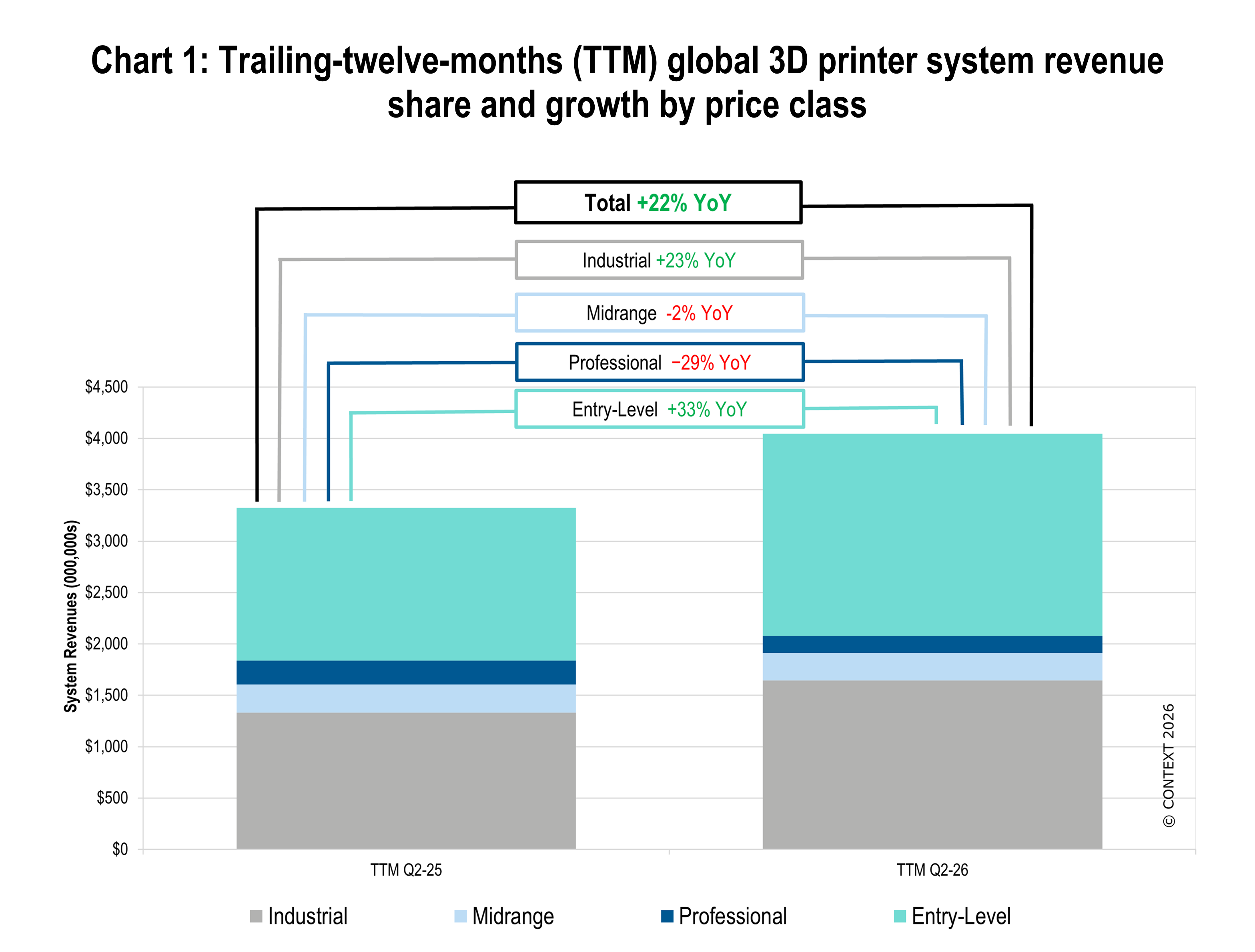
The Entry-level segment now represents the
largest market share by value, accounting for 49% of all hardware
revenues over the trailing twelve months (TTM), while the Industrial
class accounted for 41%. Strong revenue growth occurred in both
categories, with Industrial revenues rising +40% YoY in Q2 and
Entry-level revenues climbing +36% YoY. TTM revenue growth reached
+23% for Industrial and +33% for Entry-level systems.
|
There have been many catalysts for growth
for 3D printing in the past, from specialized
athletic shoes to pandemic supply-chain disruptions,
but nothing quite compares to the current demand
seen for the production of rockets, data center
infrastructure, mobile consumer electronics devices and
drones from across the globe presently. While Industrial 3D
printing used to be defined by its use to produce hearing aids
and clear dental aligners, in 2026, if you are manufacturing a
drone, a rocket, or an advanced mobile phone, you are using 3D
printing as an essential part of your manufacturing
process. Industrial Systems: Metals and Polymers
Propelled by Defence, Aerospace, and 3C |
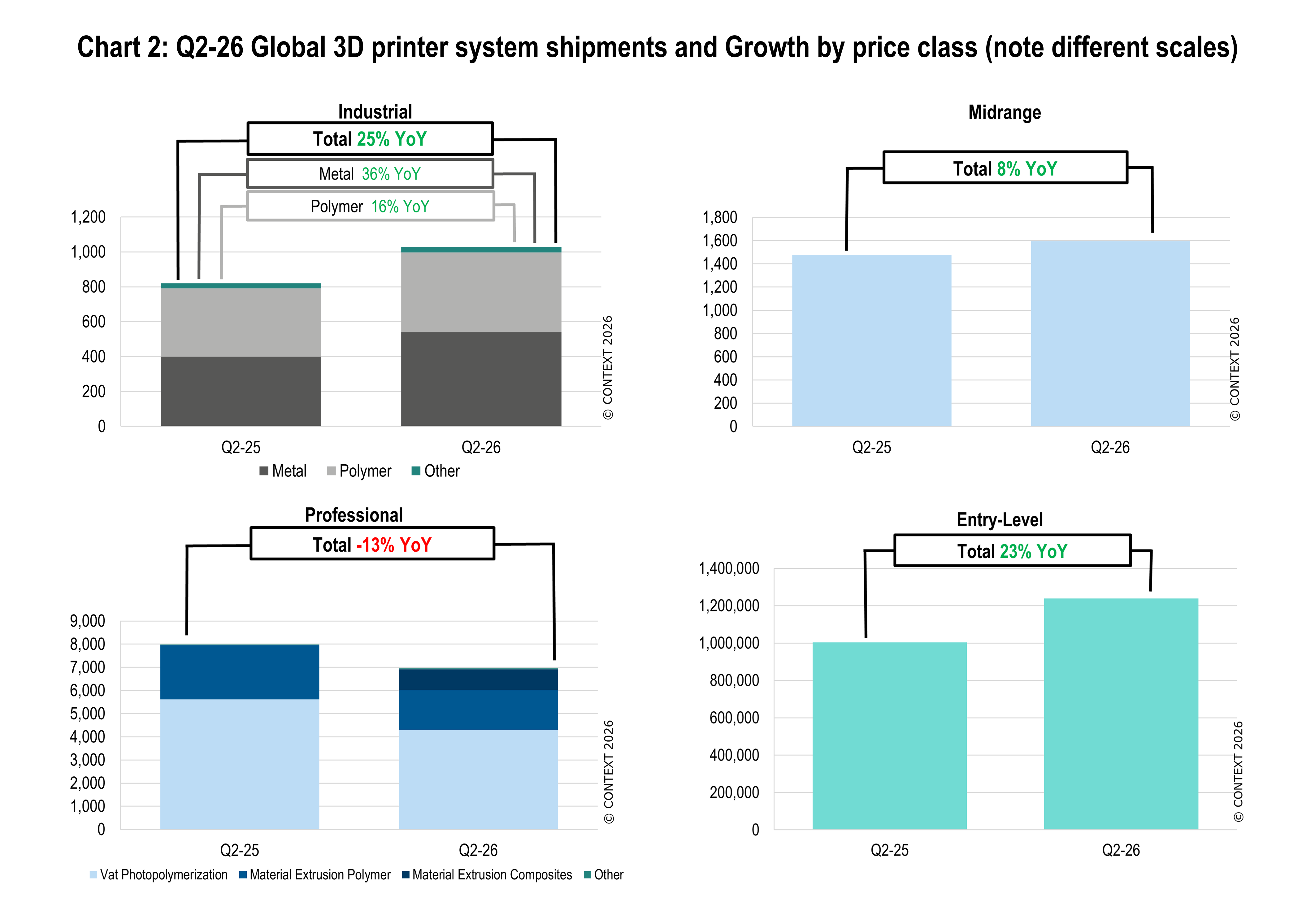
Unit shipments in the Industrial price class
(>$100K) grew +25% YoY in Q2 2026, marking the fourth consecutive
quarter of YoY growth. Global Industrial system revenues surged +40%
YoY, propelled by robust demand across key global end-markets.
While China led total global Industrial shipments
over the TTM with a 37% volume share (compared to 29% for North
America and 21% for Western Europe), quarterly shipments into North
America and China were nearly on par. Both key regions experienced
sharp growth: North American Industrial shipments rose +44% YoY, while
Chinese shipments grew +42% YoY. Regional supply dynamics remain
distinctly localized for Industrial 3D Printer shipments, with Chinese
vendors fulfilling domestic demand and Western OEMs supplying US and
European customers.
-
Metals: Metal additive systems
dominated the Industrial price class, accounting for 53% of unit
shipments and 75% of total Industrial hardware revenue in Q2.
Overall Metal printer shipments grew +36% YoY, while sector
revenues jumped +51%. Powder Bed Fusion (PBF) remained the
dominant technology, capturing 77% of Metal unit shipments and 83%
of segment revenues.
-
Metal Highlights:
Aerospace and Defence (A&D) served as the primary growth
catalyst, particularly for Western OEMs. German market leader EOS
achieved high double-digit revenue growth, supported by major
A&D orders, including 30 Metal PBF printers for drone
manufacturer Beehive Industries. Japanese-German vendor Nikon SLM
Solutions also secured orders from Beehive for its ultra-large NXG
600E systems. The UK’s Renishaw doubled its Metal PBF shipments
year-on-year, while US-based Arc Impact (owner of Desktop Metal)
reported strong domestic defense demand. In China, Farsoon and BLT
experienced strong first-half growth driven by the 3C (Computer,
Communication, and Consumer Electronics) sector, where demand for
titanium foldable phone hinges and smartphone frames surged.
-
Polymers: Industrial Polymer unit
shipments increased +16% YoY globally. Growth was led by a +39%
surge in Vat Photopolymerization shipments (driven primarily by
UnionTech in China) and steady demand for high-temperature
Material Extrusion systems. Stratasys secured significant domestic
and APAC orders for its flagship F900 platforms. 3D Systems
reported strong Q2 system sales with a positive Q3 outlook,
highlighting its largest single order to date for Industrial
Polymer systems destined for reusable rocket manufacturing.
Additionally, HP secured an order from service bureau ADDMAN for
81 5620 MJF printers, expanding ADDMAN's total fleet to 125
units.
Midrange and Professional Systems: Share Shifts and New Modalities
The middle price bands continue to face pressure
from Entry-level systems cannibalizing traditional Material Extrusion
(FDM/FFF) demand. However, technological shifts and industry
consolidation are reshaping these segments.
-
Midrange ($20K–$100K): Global unit shipments
rebounded +8% YoY in Q2 2026, while segment revenues rose
+3%. The category is experiencing a structural pivot toward
Polymer Powder Bed Fusion (SLS), which saw shipments jump
+38% YoY. Further momentum is expected as Raise3D and others
continue their rollouts alongside upcoming launches
including Formlabs Fuse X1 and HP Jet Fusion 1200.
-
Professional ($2.5K–$20K): Unit shipments
contracted -13% YoY and revenues declined -24%, impacted by
ongoing weakness in legacy FDM systems. Despite headline
declines, product innovation remains active. Shipments of
Composite Material Extrusion systems commenced following
FibreSeek's Kickstarter fulfillment, while Stratasys' pending
acquisition of Markforged is set to further consolidate the
composite sector. Additionally, lower-priced full-color Material
Jetting platforms from vendors such as Flashforge (CJ270) and
HeyGears (G1X) are expected to revitalize activity in upcoming
quarters.
Entry-Level Systems: Record Exports and Market Expansion
Shipments of Entry-level 3D printers (≤$2,500)
maintained strong momentum, with global unit shipments up +23% YoY and
revenues climbing +36% YoY in Q2. China accounted for nearly 95% of
all global Entry-level printer shipments over the TTM, serving as the
central hub for technical innovations such as AI integration,
multi-color printing, and automated purge-tower management.
The "Four Little Dragons of Shenzhen"
(Bambu Lab, Creality, Elegoo, and Anycubic) combined for 87% of global
Entry-level unit shipments in Q2 2026. While Bambu Lab registered nice
growth and far-and-away maintained its leading market share, other
brands saw strength in the quarter as well: Flashforge shipments
jumped 70%+ YoY, and Snapmaker shipments surged nearly +3,000%
following fulfillment of its U1 Kickstarter campaign.
However, signs of potential market saturation are
emerging. Chinese 3D printer exports grew +58% YoY in Q2 2026,
bringing total first-half exports to 3.9 million units. While part of
this increase reflects seasonal inventory preparation for the Q4
holiday period, the surge highlights a potential gap between shipping
volumes and end-market absorption. Creality issued a profit warning
citing price competition, noting essentially flat 1H 2026 revenues
from 3D printer sales. Concurrently, major vendors including Bambu Lab
are expanding into adjacent product categories like laser engravers
and UV printers, possibly giving indication that they see a
forthcoming slow-down in growth in 3D Printer shipments. Nevertheless,
demand remains robust supported by hobbyists expanding multi-printer
setups and the rapid proliferation of high-volume print farms
globally, particularly in domestic China.
*Price classes: Entry-level <$2,500;
Professional $2,501 to $20,000; Midrange $20,001 to $100,000;
Industrial above $100,000