Autumn normally brings a steady build in PC
gaming sales. Enthusiasts refresh their hardware ahead of big game
releases and holiday promotions, and retailers plan around it.
The August 2026 channel data does not fit that
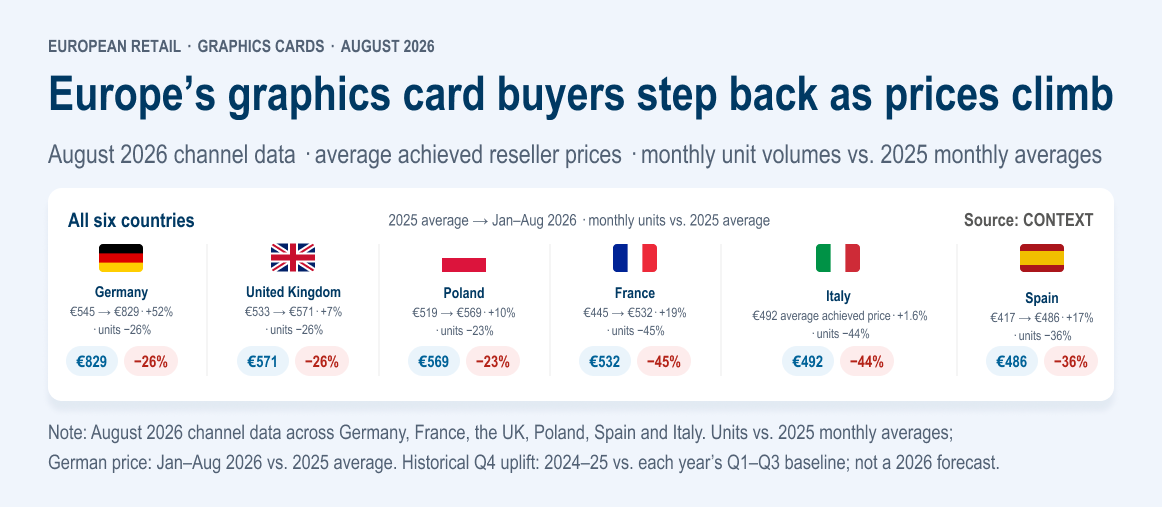
pattern. Across Europe’s main retail markets, graphics card prices
have risen sharply over the past eight months, and buyers have
responded by largely staying away. Unit volumes are down by double
digits in every market we monitor.
Retailers now face a choice before the Q4 “Golden
Quarter” begins. They can hold margins on weak volumes, or cut prices
deeply enough to release demand that has been building since the start
of the year.
Higher prices, fewer units
Achieved reseller sell prices rose steadily
across all six territories through the first half of the year and
into late summer. Several markets set monthly price records along
the way.
Volumes fell between 23% and 45% against 2025
monthly averages. Higher prices have softened the effect on revenue,
but the drop in units suggests mainstream builders and gamers are waiting.
Tolerance for higher prices varies by market.
Germany can absorb more before demand slows. In Southern Europe,
affordability ceilings sit around €400 to €450. Once prices cross
them, volumes fall steeply, whatever the size of the increase.
Germany
Germany saw the largest price rise in Europe.
Average reseller prices went from €445 in 2024 to €545 in 2025, then
to €829 over the first eight months of 2026, an increase of 52% on the
previous year. In May they peaked at €1,037.
German buyers have long paid for
high-specification cards. Even so, prices near €1,000 appear to have
restricted mainstream sales. Monthly unit sales were 26% below the
2025 average.
France
French prices rose 19%, from €445 in 2025 to €532
so far in 2026. They peaked at €604 in August.
Volumes fell 45%, the steepest decline of the six
markets. French buyers proved highly sensitive to price. Once prices
passed €500 in early 2026, monthly volumes shrank by more than 75%
from their December 2025 peak.
United Kingdom
UK prices rose from €480 in 2024 and €533 in 2025
to €571 so far this year, up 7%. The high came in April, at €658.
Monthly sell-out volumes were 26% lower than a
year earlier. Consumers resisted mid-tier increases above £500
(€550), and unit velocity stayed subdued through the second and
third quarters.
Poland
Poland is the main volume hub for Central Europe.
Average prices moved from €436 in 2024 and €519 in 2025 to €569 this
year, a 10% rise, with a peak of €629 in August.
Unit sales were 23% below the 2025 average, the
smallest fall of the six. Poland is still Europe’s largest channel for
graphics cards by volume, but prices above €550 have slowed mainstream upgrades.
Spain
Spanish prices rose 17%, from €417 in 2025 to €486 so far in
2026, after €345 in 2024. They touched €556 in April.
Unit sell-out fell 36% year on year. Shoppers here react strongly
to prices above €400, and shelf velocity has dropped sharply.
Italy
Italy is the oddity. It had the smallest price increase, 1.6% to
€492, yet one of the steepest volume falls, at 44% against the 2025 average.
Three factors may explain it. The 2025 baseline looks distorted.
Prices have also crossed a firm consumer budget limit of around €450.
And Italy lacks a top-end enthusiast segment that might cushion weaker
mid-tier demand.
What Q4 may bring
The 2024 and 2025 record shows that the Q4 uplift depends on
price. In both years, retailers lifted volumes by 36% to 69% over
the Q1 to Q3 baseline by returning promotional prices to their
annual lows. Those lows were €330 to €420 in Southern and Central
Europe, and €400 to €520 in Germany and the UK.
Demand has been held back for eight months, so shoppers are well
placed to buy during Black Friday and the holiday events. A discount
of 5% on today’s elevated list prices is unlikely to move
price-sensitive gamers.
Retailers carrying stock into Q4 must decide whether to protect
unit margins or clear volume. Promotional prices closer to historical
entry points look essential to capture the holiday uplift and to avoid
an inventory overhang going into 2027.
For weekly market updates and analysis, join
our Retail
Pulse Newsletter.